
Unknown assets
Legacy devices, shadow connections and temporary vendor equipment remain outside governance.
Industrial cybersecurity must protect production, safety and recoverability across SCADA, DCS, PLC, SIS, engineering workstations, remote access and plant networks. We support Bangladesh operators in defining risk and coordinating qualified technology and implementation routes.
For power generation, grid and substation, refinery, oil and gas, water, process industry, maritime, ports and connected industrial operations.
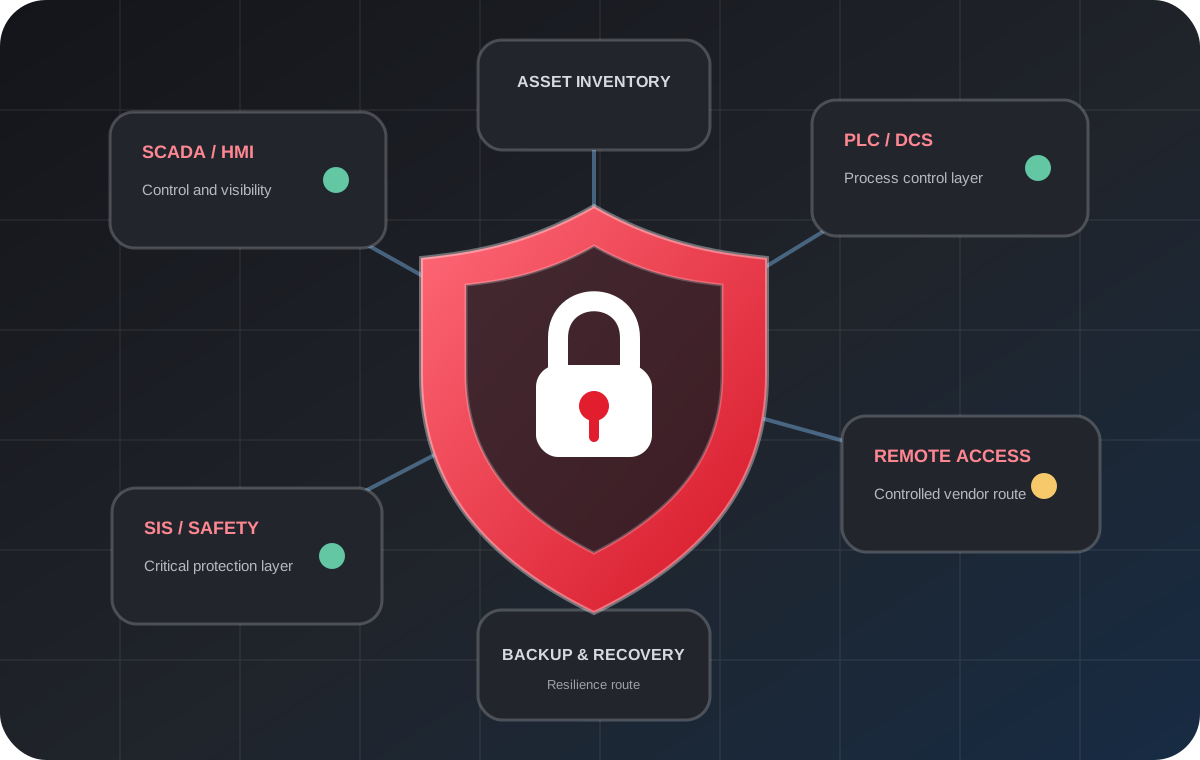
Industrial systems may run for decades, use specialised protocols, depend on vendor access and control physical equipment. A careless security change can also create downtime.
A serious programme must know the assets, restrict unnecessary trust, detect abnormal behaviour and recover the process in a controlled order.
Legacy devices, shadow connections and temporary vendor equipment remain outside governance.
Shared credentials, permanent tunnels or vendor laptops create direct pathways into critical systems.
A compromise can move farther because zones, conduits and trust boundaries are weak.
Files exist, but configuration, dependencies, recovery order or restoration testing are incomplete.
Cybersecurity products should follow verified risk. They should not be selected only because the dashboard looks advanced.
Identify devices, software, firmware, owners, criticality, communication relationships and unmanaged exposure across the industrial environment.
Review zones, conduits, trust boundaries, firewall rules and pathways between enterprise IT, DMZ, control and safety layers.
Control vendor and engineer access through identity, approval, least privilege, recording, time limits and accountable connection routes.
Observe industrial network behaviour, protocol activity, asset change and suspicious communication using a carefully engineered data path.
Prioritise weaknesses using exploitability, asset consequence, compensating controls, vendor support and planned maintenance windows.
Define roles, preserve known-good configuration, test restoration and rehearse how operations, safety, engineering and management respond together.
The scope includes hardware, software, communications, remote access, people and recovery dependencies across the industrial focus already shown on the Impro Solutions website.
| Sector | Systems and digital assets | Main cybersecurity concern |
|---|---|---|
| Power plant | DCS, turbine control, generator protection, PLC, SIS, HMI, historian and vendor access | Availability, unsafe control change, remote pathway, configuration integrity and recovery |
| Grid and substation | SCADA, EMS, RTU, IED, protection relay, substation automation, telecom and engineering tools | Wide-area consequence, time-critical protection, remote command and configuration control |
| Oil, gas and pipeline | Pipeline SCADA, compressor and pump control, ESD, terminal automation, metering and remote stations | Distributed assets, remote connectivity, process safety and loss of visibility or control |
| Water and process plants | SCADA, PLC, dosing control, pump stations, telemetry, laboratory and operator workstations | Service disruption, manipulation of process setpoints, weak remote sites and legacy systems |
| Refinery and heavy industry | DCS, SIS, APC, PLC, historians, OEM packages, engineering and maintenance laptops | Complex vendor ecosystem, flat trust, legacy protocols and high shutdown consequence |
| Maritime and port | Terminal operating systems, cranes, vessel support, navigation interfaces, access and cargo systems | Connected operational systems, third-party access, mobile equipment and service continuity |
A defensible pilot should reduce a verified risk without creating an uncontrolled connection to the plant.
Identify process owners, security authority, safety responsibilities, critical services, legal obligations and change-control boundaries.
Build the inventory, data flows, remote routes, zones, trust relationships, external dependencies and recovery priorities.
Prioritise credible scenarios and compare controls, qualified providers, references, integration impact and lifecycle support.
Test visibility, alert quality, response ownership, system impact, backup and recovery before wider implementation.
These references support risk and architecture discussions. Certification or compliance is not claimed unless formally verified.
This video card is ready for a short explainer on the route from compromised identity or remote access to an industrial control consequence, followed by the controls that break that route. It does not present a fictional Bangladesh incident or an invented client case.
Open Impro Solutions YouTubeClear scope before buying a cybersecurity platform or appointing a technical provider.
It protects operational technology and industrial control systems that monitor or control physical processes. It must consider safety, availability, process integrity and recovery, not only office data.
OT may run continuously, use specialised protocols and legacy devices, and directly affect machinery or process safety. Security changes must respect process availability, vendor support and safe shutdown requirements.
Typical scope includes SCADA, DCS, PLC, SIS, HMI, engineering workstations, historians, industrial networks, remote access, protection systems, vendor laptops, backups and connected field devices.
Begin with governance, an accurate OT asset inventory, network and data-flow understanding, criticality classification, remote-access review, backup verification and a prioritised risk register.
Many approaches use passive data sources, but every connection and architecture change needs site-specific engineering and change control. No zero-impact claim should be accepted without review.
We can support requirement clarification, qualified cybersecurity provider and OEM communication, tender and document review, local coordination, import support and pilot follow-up. Assessment and implementation remain with authorised qualified specialists.
We can review the problem statement, identify missing technical information and discuss a qualified cybersecurity technology and coordination route for Bangladesh.